I've come to a realization that I underestimate what others are feeling and I overestimate how empathetic I am.
English has been a mandatory course in the Indonesian curriculum since primary. I've always liked the class, particularly because the entertainment I enjoyed—such as music and games—is in English. I also enjoyed the textbook that was used in the class, and in general I've always found myself to be able to follow most of it.
However, I did find some parts to be slightly odd, as if they just doesn't sound natural to me—like birdwatching. In my 8 years of life at that time, I've never seen people with their binoculars gather to look at birds and jot down their note when they spotted one with a brown wing, I had never even heard of anyone doing such a thing.
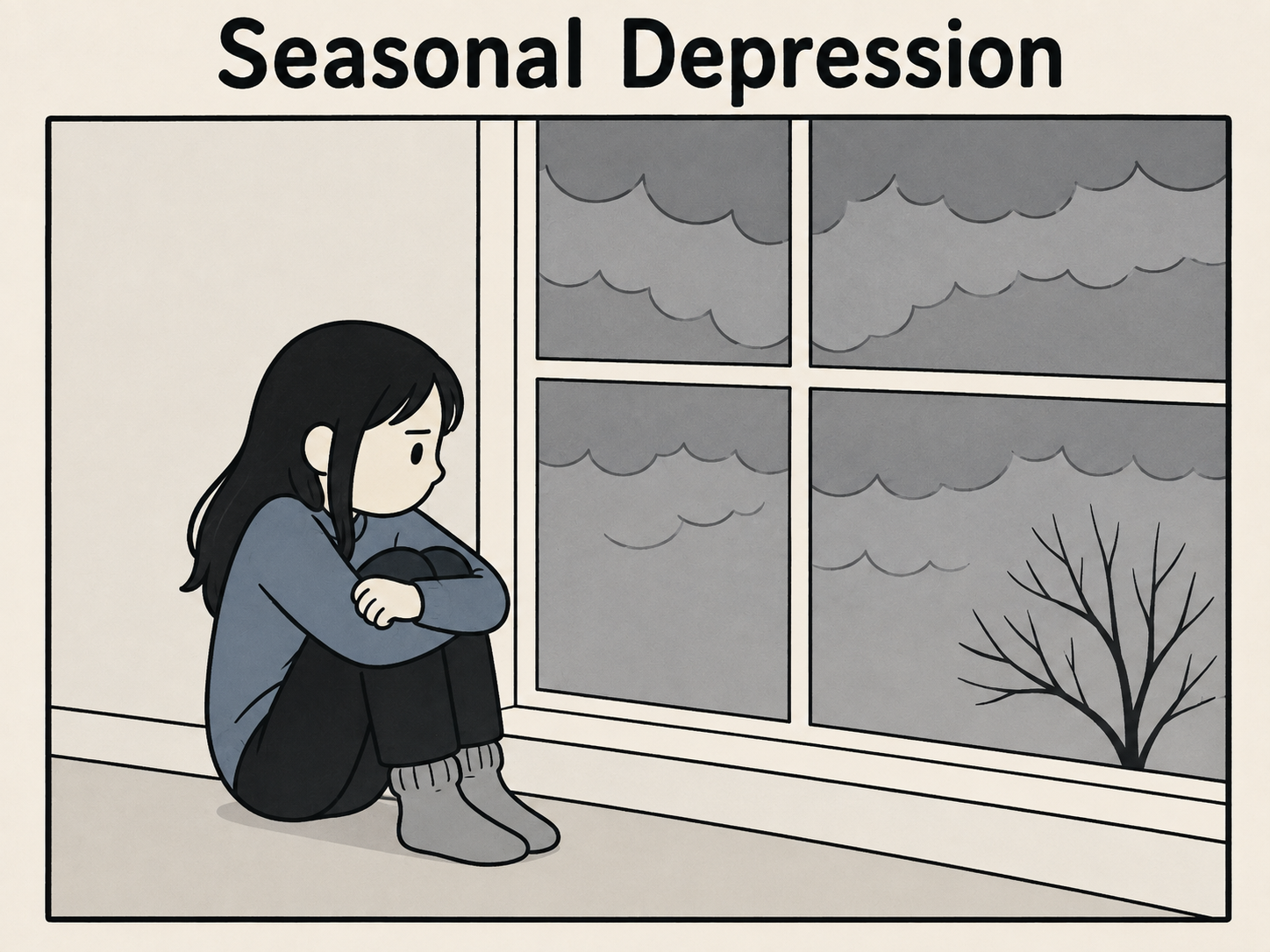
The same was true with seasonal depression, I remember vividly a cartoon drawing of a frowning girl with grey clouds outside of her window. My brain couldn't grasp how a weather could so negatively impact you emotionally, based on my experience getting a D on a test or your pet dying are the things that can make you sad, not dark skies.
Fast forward 17 years later, I started living in London for work, and I arrived alone in gloomy February—that's when I realize the frowny girl was right. Constant darkness in the morning and afternoon does make you sad! It's just that growing up and living in a tropical paradise with unlimited sunshine have impeded my ability to empathize.
Gerace et al. (2015) asked this question: does having lived through something similar make it easier to see a situation from another person's point of view?
The study involved 154 volunteers. Participants were presented with a protagonist facing one of four difficult interpersonal situations. They were asked to imagine the situation from that person's perspective, then report how easy or difficult that perspective-taking felt. They also indicated how much personal experience they had with comparable situations.
The central finding was not surprising: the more similar a participant's previous experience was to the protagonist's situation, the easier they reported finding it to take that person's perspective. In other words, experience appeared to give people a kind of cognitive foothold. Instead of constructing an unfamiliar experience entirely through imagination, they had something in their own memory to work from.
Nordgren et al. (2011) approached the similar idea through what they called an empathy gap: the hypothesis that when we are not experiencing a particular kind of pain ourselves, we tend to underestimate how strongly it affects other people. Across several experiments using a virtual ball-tossing game, they induced feelings of social exclusion in some participants by largely ignoring them in the game, receiving only around 10% of the throws. They then asked them to judge how painful rejection, bullying, or exclusion would be for someone else.
The pattern was consistent: participants who had recently experienced exclusion themselves judged similar forms of social pain as more severe than those who had not. In other words, getting even a small taste of the experience seemed to narrow the gap between observing suffering and understanding its intensity.
We often mistake the limits of our own experience for the limits of what is reasonable to feel.
Realizing how crucial past experiences are in empathizing with other people also gave me a bit more understanding why some discourse on the internet are so cruel and harsh with both parties showing almost zero compassion for the other. So much of online disagreement happens between people whose lives have given them entirely different perspectives. What feels obvious to one person may be almost impossible for another to understand, not because they are necessarily incapable of empathy, but because they have never had to live through the conditions that made that point of view make sense. And when those gaps in experience are combined with distance, anonymity, and the speed of online conversation, it'll be so easy to jump to judgement. Instead of asking, "What might have happened in this person's life for them to see the world this way?", we assume that our own experience is the neutral one and theirs is simply ignorance, weakness, or malice.
Maybe empathy does not begin with knowing exactly how someone feels. Maybe it begins with realizing how much we could not see before experience made it visible. Sometimes, like that frowning girl in my old English textbook, you can only empathize with her after spending months under London's grey sky. We may never fully know what a person has been through, but now and then life gives you a version of it, and when it does we start to listen differently, judge less and greet others with more grace. You ain't know it until you get it—and when you do, perhaps the lesson is not that you understand everyone, but to finally get just how much there is to understand.